How to Learn Fluent English Speaking: A Stage-by-Stage Plan
By Primoz, Founder of TalkHabit
Published · Updated · 10 min read
You learn to speak English fluently by speaking out loud most days, with steady listening and reading alongside. There's no single trick. "Fluent" usually means about B2 on the CEFR scale, where you can talk with a native speaker without much strain. Cambridge English estimates it takes roughly 500 to 600 guided learning hours to get there from scratch. The path runs in four stages, from first words (A1) to easy conversation on varied topics (B2 and beyond), each with a milestone that tells you when to move on. The backbone is the same at every stage: a short daily out-loud session that grows with you. Timelines vary a lot with the person, your first language and how many minutes you actually speak each day.
This guide gives you the full plan, a daily session you can start today, and self-checks so you can measure progress without a teacher.
What fluent actually means
Before you chase fluency, define it. The CEFR (Common European Framework of Reference) describes language levels from A1 to C2, and most people mean roughly B2 when they say fluent. The official CEFR self-assessment grid describes B2 speaking as interacting with enough fluency and spontaneity that regular conversation with native speakers is quite possible.
In plain words, at B2 you can:
- Keep a conversation going on familiar topics without long pauses.
- Tell a story, explain your opinion, and give reasons.
- Recover when you forget a word, by describing around it.
You will still make mistakes at B2, and that is fine. Fluency is not perfection. It is conversation without strain.
The roadmap at a glance
| Stage | Rough CEFR level | What you can do | You are ready to move on when... |
|---|---|---|---|
| 1. Beginner foundation | A1 | Introduce yourself, use set phrases, describe your day in simple sentences | You can speak for 60 seconds about your day without stopping to look things up |
| 2. Elementary | A2 | Talk about routines, past events, and small talk | You can tell a 2-minute story about yesterday and handle basic small talk |
| 3. Intermediate | B1 | Give opinions with reasons, keep conversations going, handle most travel and daily situations | You can chat for 10 minutes on a familiar topic without freezing |
| 4. Upper-intermediate and beyond | B2+ | Discuss varied topics, tell longer stories, debate, use English at work | Native-speed conversation feels tiring but not impossible |
Use the table to find yourself, then read your stage below. If you are unsure which stage fits, our guide to choosing your speaking level walks you through self-assessment.
Stage 1: Beginner foundation (A1)
Your goal here is not to know many words. It is to say a few things out loud, reliably.
Work on three skills:
- Self-introduction. Name, country, job, family, why you learn English. Ten sentences, memorized as sounds, not as spelling.
- Describing your day out loud. 'I wake up at seven. I drink coffee. I take the bus.' Same content every day is fine at this stage; you are training your mouth.
- Reading aloud. Take short, simple sentences and read them aloud until they come out smoothly.
Speaking to yourself sounds odd, but it is one of the most recommended beginner drills across independent learning resources, and it needs no partner and no schedule. If you are starting here, our 4-week beginner speaking plan at home gives you day-by-day structure.
Milestone to advance: record yourself speaking about your day for 60 seconds. If you can fill the time with simple, true sentences, start Stage 2 work alongside Stage 1 review.
Stage 2: Elementary (A2)
Now the content widens: routines, things that happened in the past, small talk. Past tenses are the big jump here, because talking about yesterday forces new grammar out of your mouth.
Daily speaking becomes non-negotiable at this stage. At A1 you can survive a skipped week and pick up where you left off. From A2 onward, your brain is building speed and automatic recall, and those fade fast without use. Five focused minutes every day beats an hour on Sunday.
Add small talk practice: greetings, weather, weekend plans, 'How was your day?' Learn a few go-to follow-up questions too, so you can keep a short exchange alive.
Milestone to advance: record a 2-minute story about something that happened yesterday, with a beginning, a middle, and how you felt. If the past-tense verbs mostly come out on their own, move into Stage 3 work.
Stage 3: Intermediate (B1)
This is where speaking practice becomes about ideas, not just sentences. Three skills matter now:
- Opinions with reasons. 'I think remote work is better because...' Push past one-sentence answers.
- Longer answers. When someone asks a question, aim for three or four sentences instead of one.
- Keeping conversations going. Learn to ask follow-ups and react: 'Really? Why is that?'
At this stage, many learners hit a frustrating wall: they understand almost everything but freeze when they speak, or they translate every sentence in their head first. Both are common and fixable. We cover the translating problem in How to Stop Translating in Your Head When Speaking English, and the understand-but-can't-speak gap more broadly in Understand a Language but Can't Speak It? Close the Gap.
Milestone to advance: hold a 10-minute conversation on a familiar topic, asking at least a few of your own questions, without needing to switch to your first language.
Stage 4: Upper-intermediate and fluency (B2+)
The last stage is about range and stamina. You can already talk. Now you need to talk about more things, for longer, with less effort.
Work on:
- Storytelling. Retell a film plot, a news story, or a family anecdote with details and reactions.
- Debates. Take a side on 'social media does more harm than good' and argue it for two minutes, even if you disagree with your own side.
- Work English. Meetings, updates, small talk with colleagues, explaining what you do.
- Paraphrasing. Practise explaining a word you do not know: 'It's a kind of tool that...'
Milestone: you have reached the fluency target from the start of this guide when native-speed conversation is tiring but possible, and you can recover from a forgotten word mid-sentence.
How long does it really take?
Cambridge English publishes rough cumulative guided-learning-hour estimates from complete beginner: about 180 to 200 hours to A2, 350 to 400 to B1, and 500 to 600 to B2, with roughly 200 hours per level from there. Their own guided learning hours guidance stresses these are guidelines, not promises, and a Cambridge teaching blog post on learning time points out that motivated adults often move between levels with fewer hours than the averages suggest.
Translate hours into real life and the range is wide. At 30 minutes of practice a day, 500 hours is close to three years. At 10 minutes a day, it stretches to nearly a decade. Your first language, your listening exposure, and how often you actually produce English move the number in either direction. So treat any timeline you read, including this one, as a rough range and not a countdown.
The daily session that carries you through every stage
Whatever your stage, the backbone is the same short loop. Aim for 10 to 20 minutes; even 5 counts on busy days. If you need help making the loop stick as a habit, our five-minute daily speaking routine covers the routine side in depth.
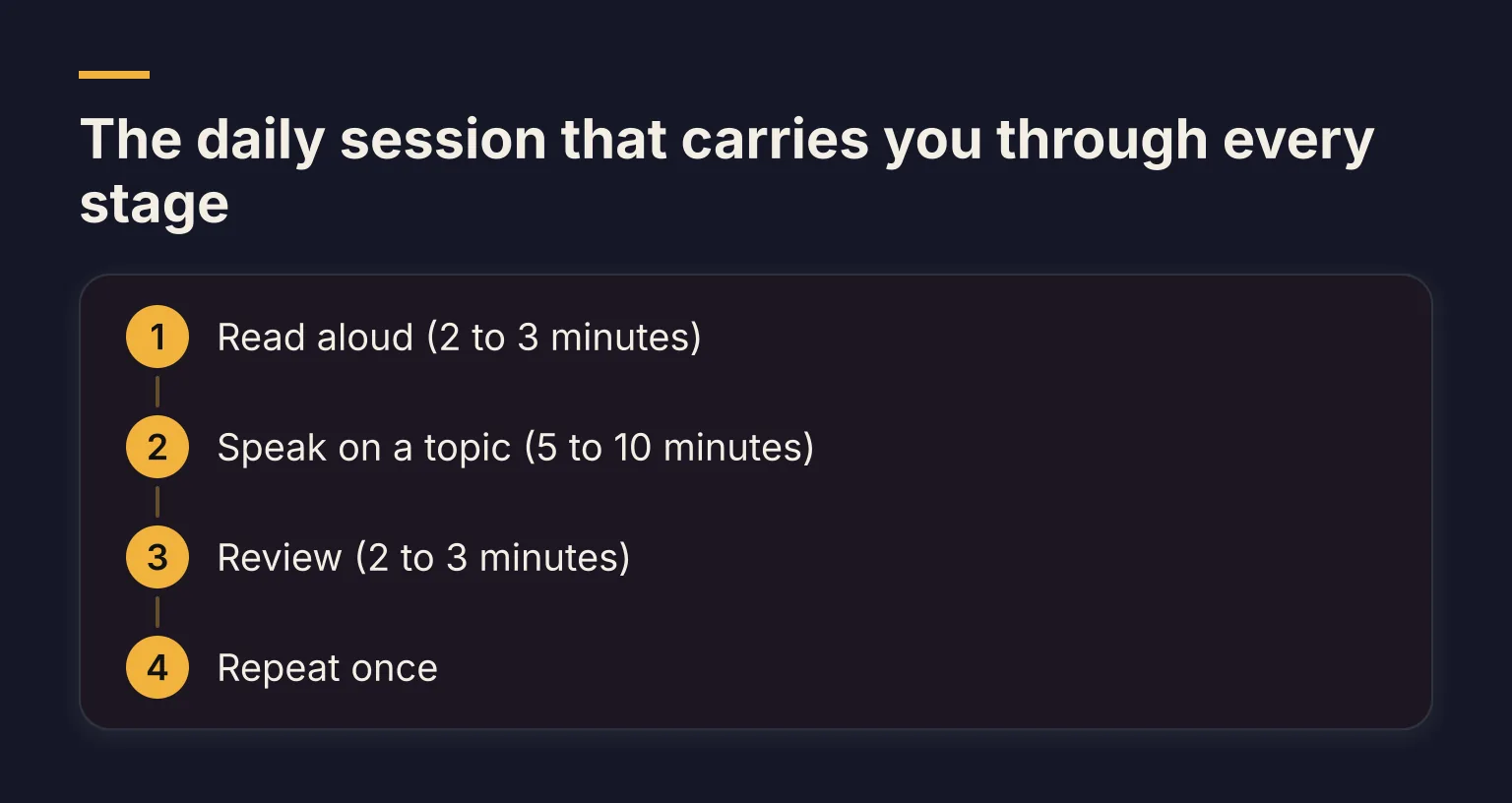
- Read aloud (2 to 3 minutes). Pick something slightly below your level and read it out. This warms up your mouth and rhythm.
- Speak on a topic (5 to 10 minutes). Describe your day, tell a story, or answer one question. No writing first; just talk.
- Review (2 to 3 minutes). Note the words you searched for or garbled. Look up two or three of them.
- Repeat once. Redo 60 seconds of the same topic, using what you just looked up.
Input matters as much as output, but balance them instead of only consuming. A rough split:
| Stage | Listening and reading | Speaking out loud |
|---|---|---|
| A1 | Most of your time: set phrases, slow audio | About a quarter, all out loud |
| A2 | Roughly half | Roughly half |
| B1 onward | Slightly under half | Slightly over half |
Watching a series counts as listening input. Speaking counts too: repeating lines after the audio, a technique called shadowing, is output as well. A systematic review of shadowing research found the technique can help with comprehensibility, intelligibility, and fluency, though most studies used controlled tasks, so treat it as a useful drill rather than a magic fix.
Getting real, level-matched conversation is the hard part of the loop. That is one reason we built TalkHabit: short daily AI voice conversations that adjust to your level, with gentle corrections and follow-up questions, so you can get out-loud practice without arranging a partner. It's built Spanish-first, but English conversations are available too. If you would rather not use an app at all, our guide to practising speaking without a partner collects the self-talk and recording drills that cost nothing. For other AI options, see our comparison of AI language learning apps for speaking. You can create a free account and start speaking in your browser, or stick with the drills above, which work anywhere.
Common obstacles, and what to do about each
- You freeze when speaking. Lower the stakes: speak to your phone's recorder instead of a person, and practise the 'buy time' phrases ('Let me think...') so pauses feel normal. For more on this, see How to Feel Less Nervous Speaking a New Language, or the British Council's tips for reducing speaking anxiety.
- You translate in your head. Shorten your sentences and drill common chunks as whole units. The fix takes weeks of repetition, not willpower.
- You missed days. Restart smaller than you stopped. One minute counts. A habit broken by a holiday is fixed by one sentence, not by guilt.
- You feel stuck at the same level for months. Check your input-output balance. Learners who only read and listen plateau; learners who only repeat the same drills get faster but not wider.
Self-check your progress without a teacher
Once a month, record the same 60-second monologue: your day, or a recent event. Compare recordings. You can also score yourself against the official CEFR self-assessment grid, which lists speaking descriptions level by level.
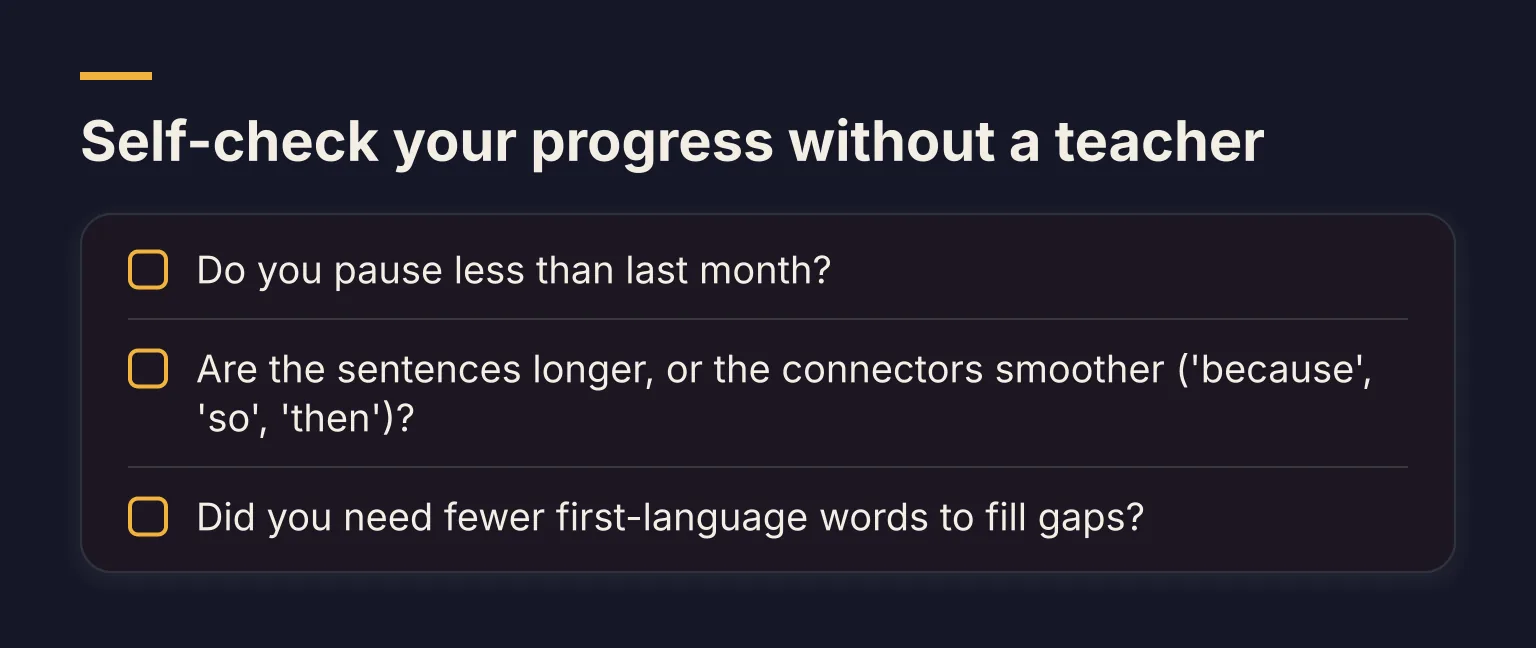
- Do you pause less than last month?
- Are the sentences longer, or the connectors smoother ('because', 'so', 'then')?
- Did you need fewer first-language words to fill gaps?
Any yes means you are moving. If every month sounds identical, change one variable: new topics, longer answers, or more speaking minutes per day.
Your next step
Find your stage in the table, then do one session today using the four-step loop above, however small. If you want a conversation partner that is always available and matched to your level, TalkHabit, the app we make, is free for five minutes a day and works in your browser.