A call with a focus.
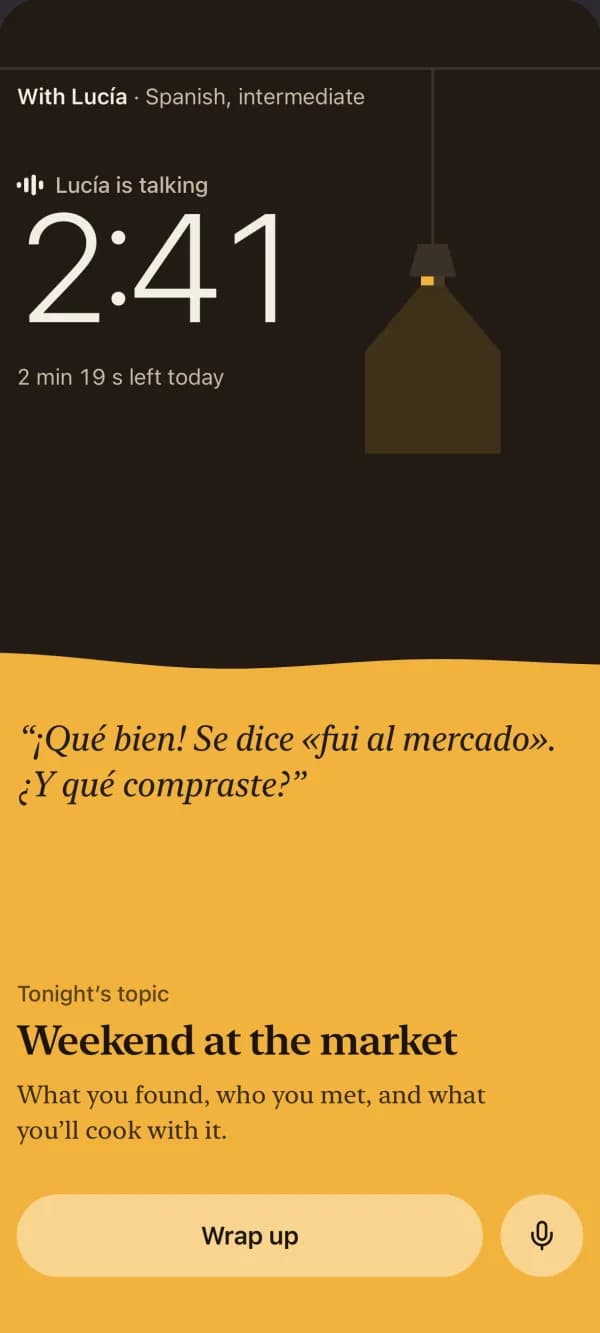
Your AI Spanish tutor chats about your day and steers the conversation into one grammar point, like the preterite and the imperfect. You answer out loud; it recasts your slips and keeps the conversation going.
Spanish speaking practice
You understand more Spanish than you can say. A short daily call with an AI Spanish conversation partner drills the grammar you fumble until you can reach for it without thinking.
Free every day · No card · In your browser and on Android
 iPhone appcoming soon
Today’s focus: preterite vs imperfect
¿Qué hiciste el sábado?
El sábado voy al mercado con mi madre.
¡Ah, fuiste al mercado! ¿Y cómo era? ¿Había mucha gente?
Fui al mercado con mi madre.
An example of how the tutor recasts and what you see afterwards
Spanish conversation practice, every day
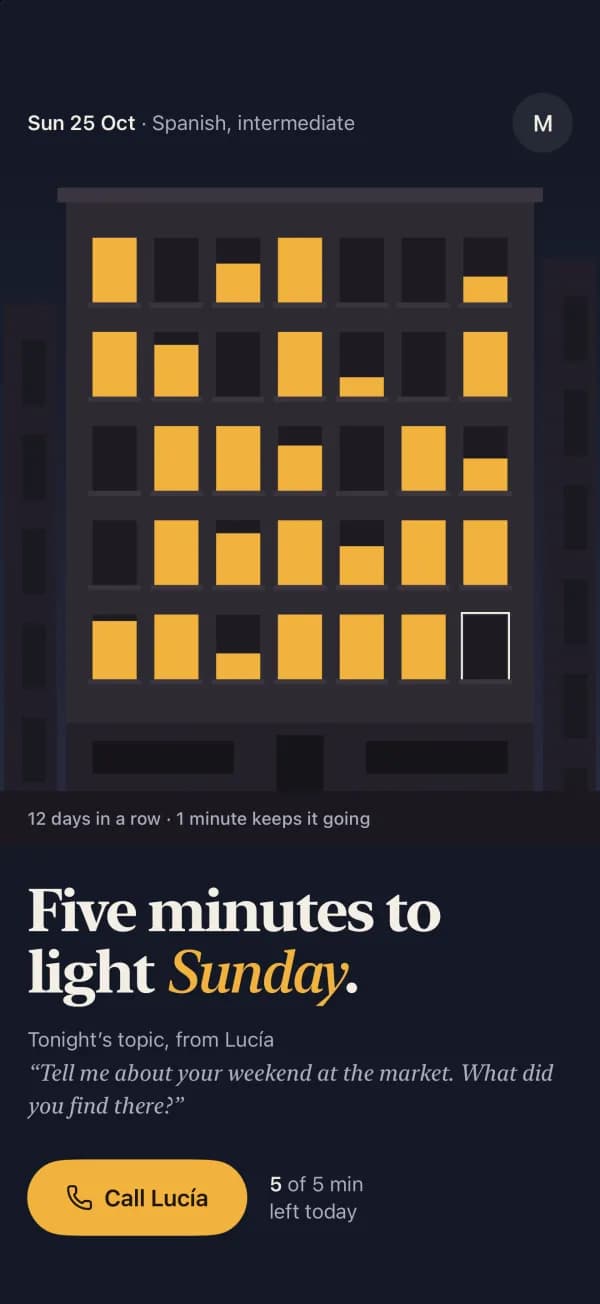
Five minutes is enough when every minute is spent speaking. One minute keeps your streak; five fills the day.
Your AI Spanish tutor chats about your day and steers the conversation into one grammar point, like the preterite and the imperfect. You answer out loud; it recasts your slips and keeps the conversation going.
When you hang up, you see up to five sentences you said, each next to the right version and a one-line why. Your own Spanish from today, not a generic lesson.
Shadow those corrected sentences and your tutor’s lines in their voice, then practise the verbs out loud on quick cards. What you miss comes back in tomorrow’s call.
The grammar you’ll drill
The structures intermediate learners trip over most, at your level. The linked ones have a free guide with spoken drills to practise before your call.
Shadowing and verb practice
Shadow the sentences you got wrong, your tutor’s own lines from yesterday’s call, and a short script for today’s grammar point.
Then verb cards ask for one form at a time, like hablar · pretérito · yo. Say it out loud, check it and hear it in your tutor’s voice. The ones you miss come back sooner.
Cuéntame qué película viste.
Soy ingeniero y estoy en casa.
↻ 2 / 3nosotros · tener · pretérito → tuvimos
The app
One account on the web and in the Android app: your partner, your streak and your plan come with you. The iPhone app is coming soon. Still comparing? Our guide to the best apps to learn Spanish sets TalkHabit next to the alternatives by how much speaking each one gets you.
A habit, not a big commitment
Talk with your partner for five minutes every day, free, for as long as you like. When you want more room, TalkHabit Plus doubles it.
The daily habit, on us.
$0 / always
No card needed. Fresh minutes every day at midnight in your timezone.
7 days free
More room to talk, every day.
$14.99 / month
or $99.99 a year: $8.33 a month, save 44%
Free for 7 days, then $14.99 a month or $99.99 a year. Cancel before the trial ends and you won’t be charged.
Prices in US dollars; checkout shows your local price, including any tax. Plus bought on the web or in the app works wherever you sign in. Terms
Questions
It’s an AI conversation partner for speaking practice. You talk out loud for a few minutes a day; it adapts to your level, steers you into one grammar point per call, corrects mainly by recasting, and shows you your mistakes afterwards. It doesn’t teach grammar lessons.
Yes. That’s what TalkHabit is for: a voice conversation whenever you have five minutes, in your browser or in the Android app (iPhone coming soon), with no one to schedule.
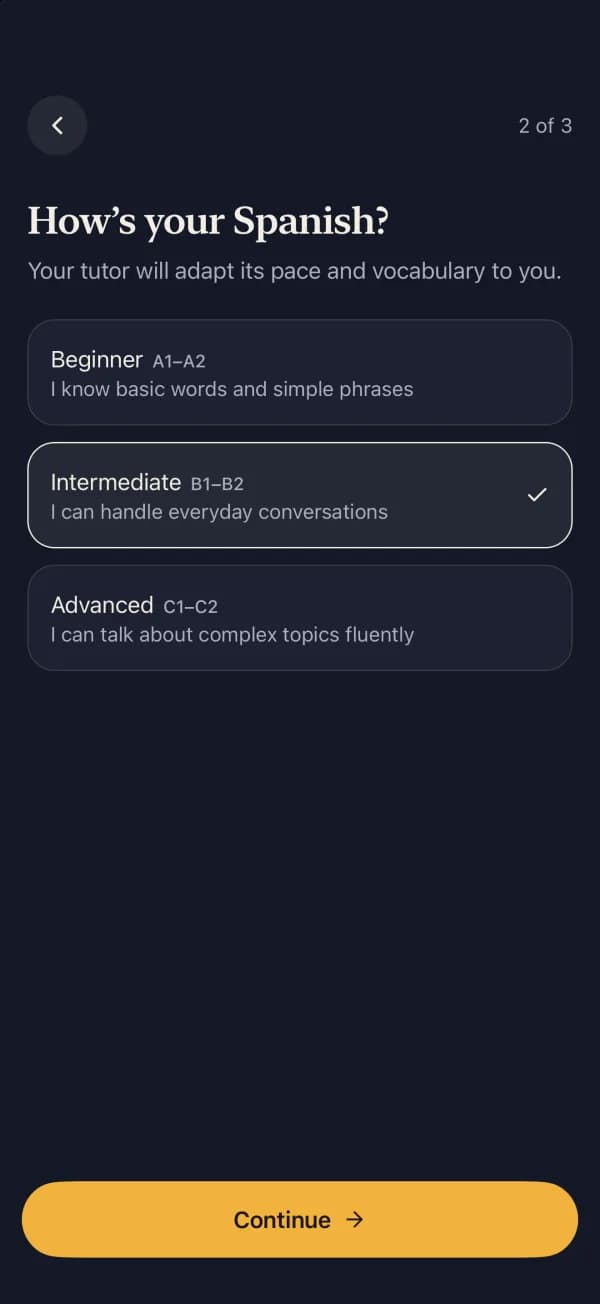
TalkHabit works best for learners who know some Spanish but freeze when speaking, roughly A2 to B2. Beginners get slower speech, simpler questions and everyday words.
Fifteen points, from ser vs estar and gustar to preterite vs imperfect, the subjunctive, por vs para, object pronouns and si clauses. Each focus is picked from your recent mistakes, at your level.
5 speaking minutes a day are free, with no card needed. TalkHabit Plus gives you up to 10 minutes a day for $14.99 a month or $99.99 a year (US dollars), and starts with a 7-day free trial.
Spanish speaking guides
Free guides from the TalkHabit blog, written for English speakers who understand more Spanish than they can say. Start with the group that matches what stops you. To see what each level covers, from A1 to C2, open the Spanish levels map.
Each guide takes one structure that intermediate learners fumble and turns it into short spoken drills, with audio for the examples. Around B1, start with por vs para: you need one of the two in almost every conversation. Then pick the tense or verb that makes you pause.
The por vs para uses that come up when you talk, with audio examples, spoken drills, fixed phrases to learn whole and the mistakes to listen for.
Ser vs estar practice you do out loud: speaking drills with audio, minimal pairs like es aburrido vs está aburrido, and the mistakes English speakers make.
Spanish preterite vs imperfect practice you do out loud: tell short stories as scene plus events, with audio examples, translations and common errors.
Spanish subjunctive practice for speaking: drills for quiero que, espero que, me alegra que, ojalá and pedir que, with audio model answers to say aloud.
Spanish conjugation practice that carries into conversation: say verbs aloud, in sentences and against a clock, with a 10-minute routine and progress log.
Stop translating Spanish in your head: the phrases English speakers get wrong (tengo hambre, me gusta, acabo de, llevo dos años) and drills to say them.
Learn the real difference between saber and conocer in Spanish, with examples, conjugation, and speaking drills to practise out loud.
Ways to get Spanish out loud every day, with or without someone to talk to: a daily routine, conversation drills on your own, shadowing, and what to add if an app got you reading Spanish but not speaking it.
Six ways to practise speaking Spanish, ranked by talk time, plus a five-minute daily routine with example answers and phrases for when a word won't come.
Question chains, two-sided scripts and the Spanish phrases that keep a chat going: how to rehearse a real conversation on your own, with examples.
Spanish shadowing practice that works: short lines, rhythm and vowel linking, what to shadow at A2–B2, and how to compare your recording with the original.
Can't speak Spanish after Duolingo? The four gaps (past tenses, the subjunctive, fast listening, recall under pressure) and what to add for each one.
Try 9 Spanish tongue twisters grouped by sound, with English translations and a drill routine for accent improvement.
Learn how to roll your Rs in Spanish with a science-backed, step-by-step 7-day plan, starting from the single tap to the full trill.
How the main apps compare on how much of the time you actually speak. TalkHabit is ours, so each comparison says so up front and judges every app, ours included, on the same criteria.
The best apps to learn Spanish in 2026, compared by how much speaking each one produces: Duolingo, Babbel, Pimsleur, AI apps, tutors and exchanges.
Six AI language learning apps compared for speaking: conversation, corrections, level fit and free tiers, with prices checked in November 2026.
Duolingo vs Speak compared on how much you actually say out loud per session, plus feedback, price, languages and level fit, with picks by learner type.
Six Duolingo alternatives compared on how much you actually speak out loud: structured, audio-first, AI and human options, with honest tradeoffs.
There’s a little time for this.
Five minutes a day. One grammar point. Your own mistakes, fixed.
Start speaking freeFive minutes a day, free · No card needed · In your browser or the app
iPhone appcoming soon