Duolingo vs Speak (2026): Which Actually Gets You Talking?
By Primoz, Founder of TalkHabit
Published · Updated · 10 min read
For speaking, Speak usually beats Duolingo, as long as your language is one of its six and you're willing to pay after the 7-day trial. Most of a Speak session is you talking. Most of a Duolingo session is tapping, matching and typing, with short spoken bits. Duolingo wins on almost everything else: a real free tier, 40+ languages, and a quiet, tap-first design you can use on a bus. So the better question is which gap you're trying to close.
How we compared them
The main test is simple: in a normal session, how much do you say out loud yourself? Everything else follows from that, plus five supporting questions:
- How useful is the feedback, during and after speaking?
- What do you get free, and what does a committed learner pay?
- Is your target language available?
- Does it fit your level, from absolute beginner to intermediate?
- Can you realistically use it every day, where and when you study?
This comparison is based on each company's own help pages, pricing and app store listings, checked on 3 November 2026, plus what learners report. We haven't run timed tests, so there are no scores.
Duolingo vs Speak at a glance
| Duolingo | Speak | |
|---|---|---|
| Core method | Gamified course covering reading, listening, typing and some speaking | Learn, practise, then use phrases in conversation with an AI tutor |
| Speaking per session | A minority of the session; mostly tapping and short spoken lines | Most of the session is you talking |
| Feedback | Mostly right-or-wrong scoring; Explain My Answer is free | Real-time feedback on pronunciation and phrasing, plus Smart Review of your mistakes |
| Open conversation | Roleplay and Video Call on paid plans, mobile app only | AI tutor conversations throughout the course |
| Free access | All lessons free, with ads | 7-day free trial, then a subscription |
| Price (US, November 2026) | Super and Max; prices shown in the app | Premium $17.99/month or $83.99/year; Premium Plus $39.99/month or $164.99/year (App Store) |
| Languages | 40+ | 6 for English speakers, plus English for speakers of 15 languages |
| Best for | A free daily habit and broad, quiet study | The most speaking per minute |
Neither app is ours. If what you really want is a few minutes of speaking every day, TalkHabit, the app we make, is a third option, covered at the end; its free plan needs no card.
Duolingo: a free habit machine that talks in small doses
Duolingo teaches 40+ languages, and every lesson on the course path is free. The daily streak and bite-sized lessons make it easy to show up every day, which is a genuine strength.
Speaking on Duolingo has improved. Regular lessons include microphone exercises, and Explain My Answer, which tells you why an answer was wrong, is now free for all learners. The real conversation features are Roleplay and Video Call with Lily. According to Duolingo's help centre, both are part of Duolingo Max and work only in the mobile app. Roleplay covers English speakers learning French, Spanish, German, Portuguese and Italian, and Video Call covers learners of English, French, Spanish, Italian, German and Portuguese. In its 2026 shareholder letters, Duolingo said it is moving Video Call into the cheaper Super tier. By August, most new Super subscribers had it.
Where Duolingo falls short is spoken output. The speaking you do in normal lessons is often reading a set sentence aloud rather than building your own. That's a deliberate bet, not a flaw: Duolingo assumes you'll build vocabulary and grammar through high-volume drills, and that speaking comes later. Learners who study on a commute, in an office or in shared housing often can't speak aloud anyway, and there its quiet design is a real advantage.
If you've kept a long streak but freeze when a real person asks you a question, you're not alone. Learners describe that gap in a r/languagelearning thread about the Speak app and in our article on quitting Duolingo after a long streak.
Speak: speaking-first lessons, behind a subscription
Speak is built around the opposite loop. You learn a handful of phrases native speakers actually use, say them out loud straight away, then use them in roleplays and conversations with an AI tutor. Speak promises "real-time feedback on pronunciation and phrasing", and its Smart Review is built from your own mistakes.
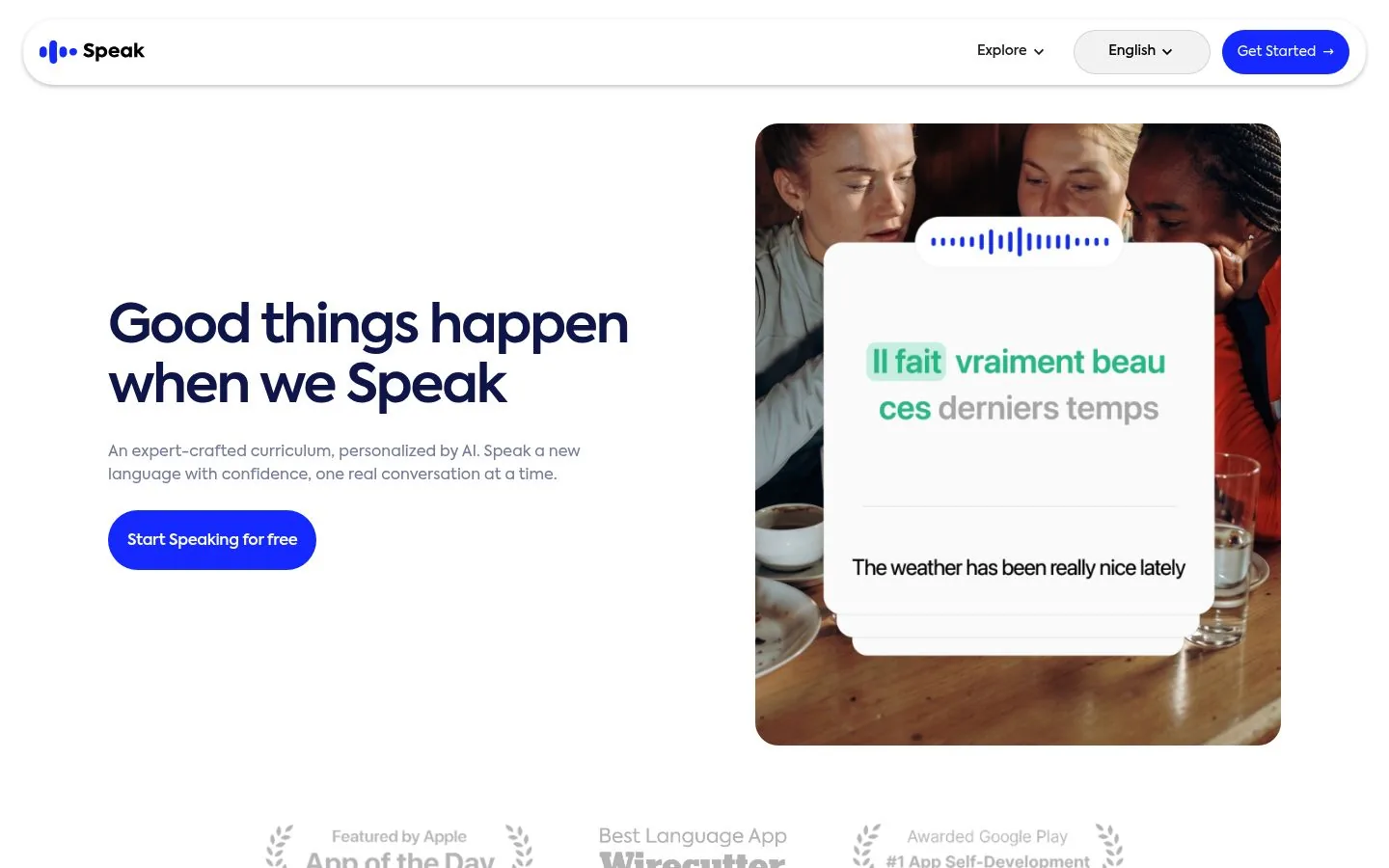
Per session, you speak far more here than in a typical Duolingo lesson. That is the whole design. If your problem is that you know some of a language but freeze when you have to produce it, that session shape fits you well.
The tradeoffs are real, though:
- Narrow language list. According to Speak's help centre, English speakers can learn Spanish, French, Japanese, Korean, Italian or Simplified Chinese. Speak also teaches English to speakers of 15 other languages. Its Japanese, Italian and Korean courses are newer betas that only start at beginner level.
- No lasting free tier. Speak has a 7-day free trial. Cancel at least one day before it ends or you'll be charged.
- Two paid plans. Premium includes the curriculum, roleplay, the Speak Tutor and Smart Review, plus up to three custom lessons a day built from your mistakes. Premium Plus makes those lessons unlimited and adds a personalised study plan.
Which one gets you talking more?
Per minute of use, Speak produces far more real spoken output, because talking is the session rather than a garnish on it. Duolingo produces the least, by design.
But more speaking per minute only matters if you actually do the sessions. Duolingo's free tier, game loop and 40+ languages make it the app people are most likely to open every day. An app you don't open gets you zero words spoken.
Feedback and corrections
- Duolingo is scoring-oriented. It tells you quickly whether an answer was right, and Explain My Answer says why. It isn't designed to coach your phrasing in conversation, except in the paid AI features.
- Speak builds feedback into the speaking loop: pronunciation and phrasing as you go, then Smart Review collects your mistakes for later. You don't tune it; the app decides when and how to correct. For a beginner, that's probably the right kind of simple.
If your goal is sounding natural in back-and-forth conversation, correction style matters more than lesson count.
Pricing and free access
Prices below are US prices as of November 2026. Both companies vary prices by country and run promotions, so check the app before you pay.
- Duolingo: the full course path is free, with ads. Super removes ads and adds extras such as practice built from your mistakes, and Max adds Roleplay and Video Call. Duolingo shows Super and Max prices in the app; see its Super help page for what each tier includes.
- Speak: 7-day free trial, then Premium at $17.99 a month or $83.99 a year, or Premium Plus at $39.99 a month or $164.99 a year, per its US App Store listing. Speak says the most accurate price is always shown in the app.
Language coverage
This is the clearest tiebreaker. Duolingo offers 40+ languages, which covers most learners. Speak offers six for English speakers: Spanish, French, Korean, Japanese, Italian and Simplified Chinese. If your language isn't one of Speak's six, the decision often ends here.
Level fit
- Absolute beginners: Duolingo's gentle start works well. Speak expects you to start producing quickly, which suits some beginners and overwhelms others.
- False beginners (you studied before but can't speak): this is Speak's sweet spot, because it forces you to produce from the first session.
- Intermediate learners wanting open conversation: Duolingo's course path runs out of road here. Speak fits better, though its Japanese, Italian and Korean courses only have beginner content so far. At some point you'll outgrow both apps' lesson structure, and open conversation matters more than new XP. Our guide to practising speaking without a partner covers what to do then.
Practical constraints
- Can you speak aloud where you study? If not, Duolingo's tap-first design wins by default.
- Prefer the web? Duolingo works in a browser as well as its apps, though Max's AI features are mobile-only.
- Commuter or shared-space learner? Whether you can study quietly shapes the decision more than features do.
Which should you pick?
- You want the most speaking per minute, and your language is Spanish, French, Korean, Japanese, Italian or Chinese: Speak. Start with the 7-day trial to see whether the price is worth it to you.
- You want a free daily habit, especially for a language Speak doesn't offer: Duolingo, knowing you'll need to add speaking practice elsewhere.
- You're a false beginner who freezes when speaking: Speak first, with Duolingo as a quiet supplement.
- You can only practise silently: Duolingo now, plus a plan to add speaking when your situation allows.
A third option: daily open conversation
Neither app gives you long, open, level-adjusted daily conversation. Duolingo's free path is mostly drills, and Speak's conversations follow its curriculum. If your problem is that you understand the language but freeze when you have to speak it, a short daily speaking habit is the fix, whichever app you keep.
That's the gap TalkHabit, the app we make, is built for. You talk out loud with a personal AI partner for a few minutes a day at your level. It recasts your mistakes as you go and remembers what you said yesterday. On the web, it then shows you the sentences you got wrong next to the corrected versions. You can shadow those corrections in your partner's voice. It's free for 5 minutes a day. TalkHabit Plus gives up to 10 minutes a day for $14.99 a month or $99.99 a year (US prices as of November 2026), after a 7-day free trial.
Its limits: TalkHabit is Spanish-first (English, French and German are also available), it runs in a browser and on Android with no iPhone app yet, and it isn't a course. It won't teach you a language from scratch the way Duolingo or Speak does. If you want daily conversation alongside either app, you can create a free account. For more options beyond these two, see our 2026 roundup of AI language learning apps. If you're leaning away from Duolingo entirely, see the best Duolingo alternatives for speaking, and if Speak is on your shortlist, our Langua vs Speak comparison.
Frequently asked questions
Is Speak better than Duolingo for speaking? Generally yes, because speaking is Speak's core design, while Duolingo's standard lessons produce limited speech. But Duolingo wins on free access and language coverage.
Is Speak free? Only as a 7-day trial. After that it needs a Premium or Premium Plus subscription. Duolingo's core lessons are free, with Super and Max as paid tiers.
How much does Speak cost? In the US App Store as of November 2026, Premium is $17.99 a month or $83.99 a year, and Premium Plus is $39.99 a month or $164.99 a year. Prices vary by region.
Which languages does Speak support? For English speakers: Spanish, French, Japanese, Korean, Italian and Simplified Chinese, plus English courses for speakers of 15 other languages, per Speak's help centre.
Does Duolingo have AI conversation practice? Yes, but on paid plans and in the mobile app only: Roleplay and Video Call with Lily are Max features, and Duolingo has been moving Video Call into Super during 2026.