Langua vs Speak (2026): Which App Improves Your Speaking?
By Primoz, Founder of TalkHabit
Published · Updated · 9 min read
If you already have some basics and want lots of real conversation, Langua fits better. If you're starting from zero and want a course to follow, Speak fits better. Both apps aim for the same result, getting you to speak your target language out loud more often and with fewer mistakes, but they get there in very different ways.
Langua is an open AI conversation coach. You talk about what you want, choose how it corrects you, and get a detailed feedback report after each chat. Its free tier is tiny but permanent. Speak is a structured course: you learn phrases, practise them with instant feedback, then use them in conversation with its AI tutor. It's beginner-friendly, but it teaches six languages to English speakers and has no permanent free tier.
Every fact below comes from each company's own help pages and app store listings, checked on 3 November 2026. We haven't run timed tests, so there are no scores.
| Langua | Speak | |
|---|---|---|
| Approach | Open AI conversation coach you steer | Structured course with an AI tutor |
| Corrections | Five correction modes you choose, plus feedback reports | Real-time feedback in lessons, plus Smart Review |
| Free tier | Small but permanent | 7-day trial only |
| Paid plans (US App Store, November 2026) | From $19.99/month or $149.99/year | From $17.99/month or $83.99/year |
| Languages | 23, many in more than one dialect | Six for English speakers |
| Best fit | Intermediate and above, wants conversation | Beginners who want a course to follow |
The short answer, by learner profile
| If you are... | Pick | Why |
|---|---|---|
| An absolute beginner | Speak | Lessons start from zero and walk you through each phrase. |
| Intermediate and hungry for conversation | Langua | Open chats and role plays give you far more talking time. |
| Learning a less common language | Langua | 23 languages, many in more than one dialect. Speak teaches six to English speakers. |
| Paying monthly | Either | Speak's cheapest monthly plan is $17.99, Langua's $19.99 (US App Store). |
| Committing for a year | Check both | Speak's annual Premium is cheaper. Langua's money-back guarantee only covers web and Android subscriptions, so read the buying notes below. |
Neither app is ours. If you mainly want to speak out loud more often, TalkHabit, the app we make, is mentioned at the end; its free plan gives you five minutes a day with no card.
Langua (LanguaTalk): an open conversation coach you steer
Langua, from the tutoring platform LanguaTalk, is built around unscripted conversation. You pick a topic or a role play and talk, by text or in a voice call mode. Its voices are cloned from real native speakers, and you can set the conversation to your level. For lower levels (A1 and A2) there's a guided conversational course.
Where Langua shines for serious learners is what happens around the chat. You choose how strictly it corrects you (more on that below), and after each conversation you can get a detailed feedback report on your mistakes.
The tradeoff: Langua assumes you can drive. There's a beginner course, but if you want an app to tell you exactly what to do each day, an open coach can feel loose. If you're weighing whether open AI conversation suits you at all, our guide to using an AI conversation partner covers what this style of practice can and can't do.
Speak: a structured lesson loop with a tutor on call
Speak takes the opposite approach. Its method runs in a loop: learn phrases native speakers actually use, practise them until they're automatic, then use them in conversation with the Speak Tutor AI.
The paid plans differ in how much personalisation you get. According to Speak's plan comparison, both Premium and Premium Plus include the curriculum, situational role play, the Speak Tutor and Smart Review. Premium also includes up to three custom lessons a day built from your mistakes. Premium Plus makes those unlimited and adds a personalised study plan. One detail: the Pronunciation Coach is only available to learners of English.
The tradeoff: the rails that make Speak comfortable for beginners also make it less flexible. You follow the course; you don't wander into a debate about football at minute two.
How each app corrects you
This is where the two philosophies are easiest to feel.
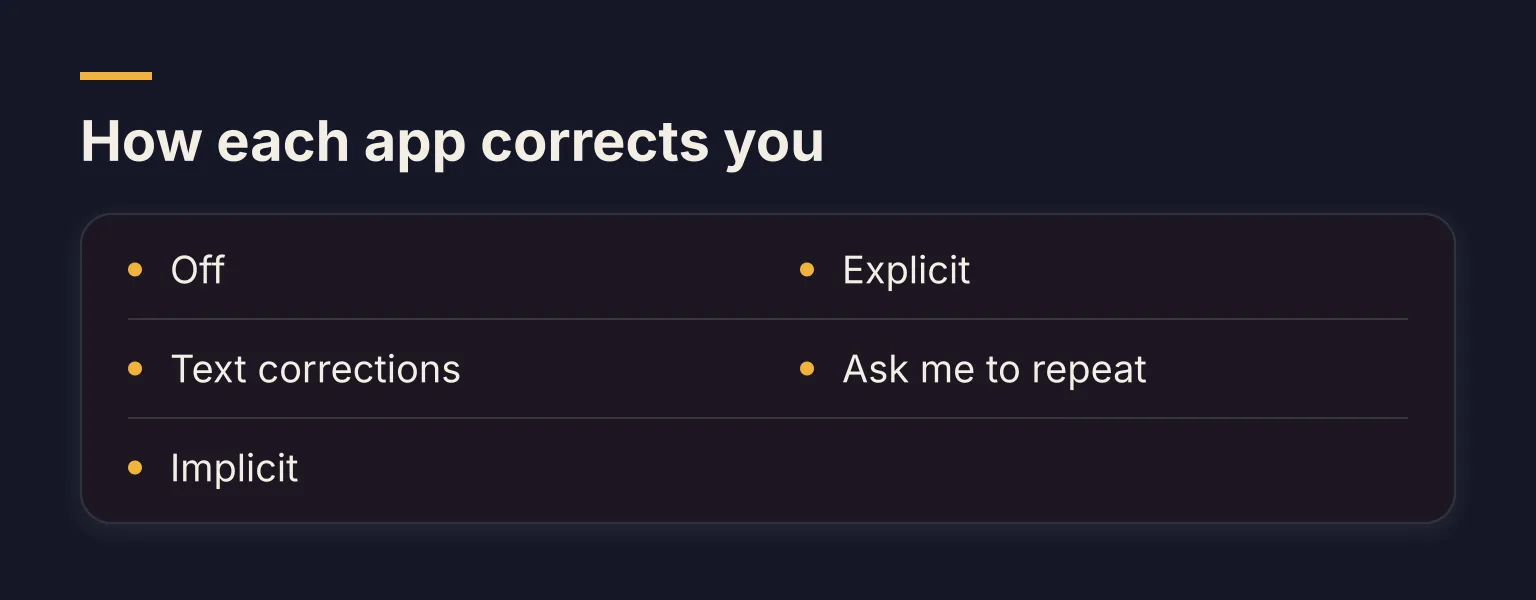
On Langua, you choose one of five correction modes, described in Langua's help guide on corrections:
- Off: nothing mid-chat.
- Text corrections: mistakes crossed out and corrected under your reply.
- Implicit: the AI works the correct form naturally into its own reply.
- Explicit: the AI points out the error, then carries on.
- Ask me to repeat: the AI has you say the corrected phrase before continuing.
That last one matters. Saying the corrected sentence out loud is exactly the repetition that builds speaking habits. One honest caveat from Langua's own docs: the AI sometimes misses a mistake. Langua says that in its testing it spots errors around 95% of the time.
Speak corrects in real time as you speak, flagging pronunciation and phrasing inside the lesson, and Smart Review collects your mistakes into review material afterwards. You don't tune this; the app decides when and how to correct. That's simpler, and for a beginner it's probably the right kind of simple.
Conversation and level fit
Langua adapts to the level you set, and its voices are cloned from native speakers, with dialect options for many languages. Intermediate and advanced learners get the most out of it, because open conversation only pays off once you can keep a thread going.
Speak is friendlier lower down. The structure gives total beginners quick wins, and it helps if you freeze when given a blank conversational slate. One caveat: Speak's help centre says its Japanese, Italian and Korean courses are still in beta and only have beginner content so far.
If you're unsure where you sit, our guide to choosing your speaking level walks through it.
Costs and free tiers
Here the difference is stark. Prices below are US App Store prices as of November 2026. Both companies vary prices by region and run promotions, so check before you buy.
| Langua | Speak | |
|---|---|---|
| Free tier | Yes, but small: about 3 minutes of call mode a day and roughly 20 chat messages a week, per Langua's support page | No permanent free tier; a 7-day free trial |
| Paid plans | Standard (called Communicate in the App Store): up to 75 chat messages and 30 minutes of calls a day, $19.99/month or $149.99/year. Unlimited: $29.99/month or $199.99/year | Premium: $17.99/month or $83.99/year. Premium Plus: $39.99/month or $164.99/year |
| Trial terms | A card is needed for the Pro trial: 5 days on monthly billing, 7 days on annual | 7-day trial; cancel at least a day before it ends or you're charged |
| Refunds | 30-day money-back guarantee, but only on web or Android subscriptions, not App Store purchases | We didn't find a money-back guarantee in Speak's help centre; the trial rules apply |
Speak says its prices vary by plan, region and promotion, and that the most accurate price is always shown in the app.
Languages: the biggest practical difference
Langua's support pages list 23 languages, many in more than one dialect, including Spanish, French, German, Italian, Portuguese, Japanese, Korean and Arabic. If you're learning anything outside the biggest six, this alone may decide the comparison.
Speak teaches English speakers six languages: Spanish, French, Korean, Japanese, Italian and Simplified Chinese, per its own language list. It also teaches English to speakers of 15 other languages.
Buying notes before you subscribe
- Langua: subscribe on the web or Android if you want the 30-day money-back guarantee. Apple controls App Store refunds, as Langua explains on its pricing help page.
- Speak: the trial renews automatically. Speak's trial page says to cancel at least one day before it ends, and that cancelling keeps your access for the rest of the trial.
- Both: check current prices in each app, since both vary by region and run promotions.
Which one should you choose?
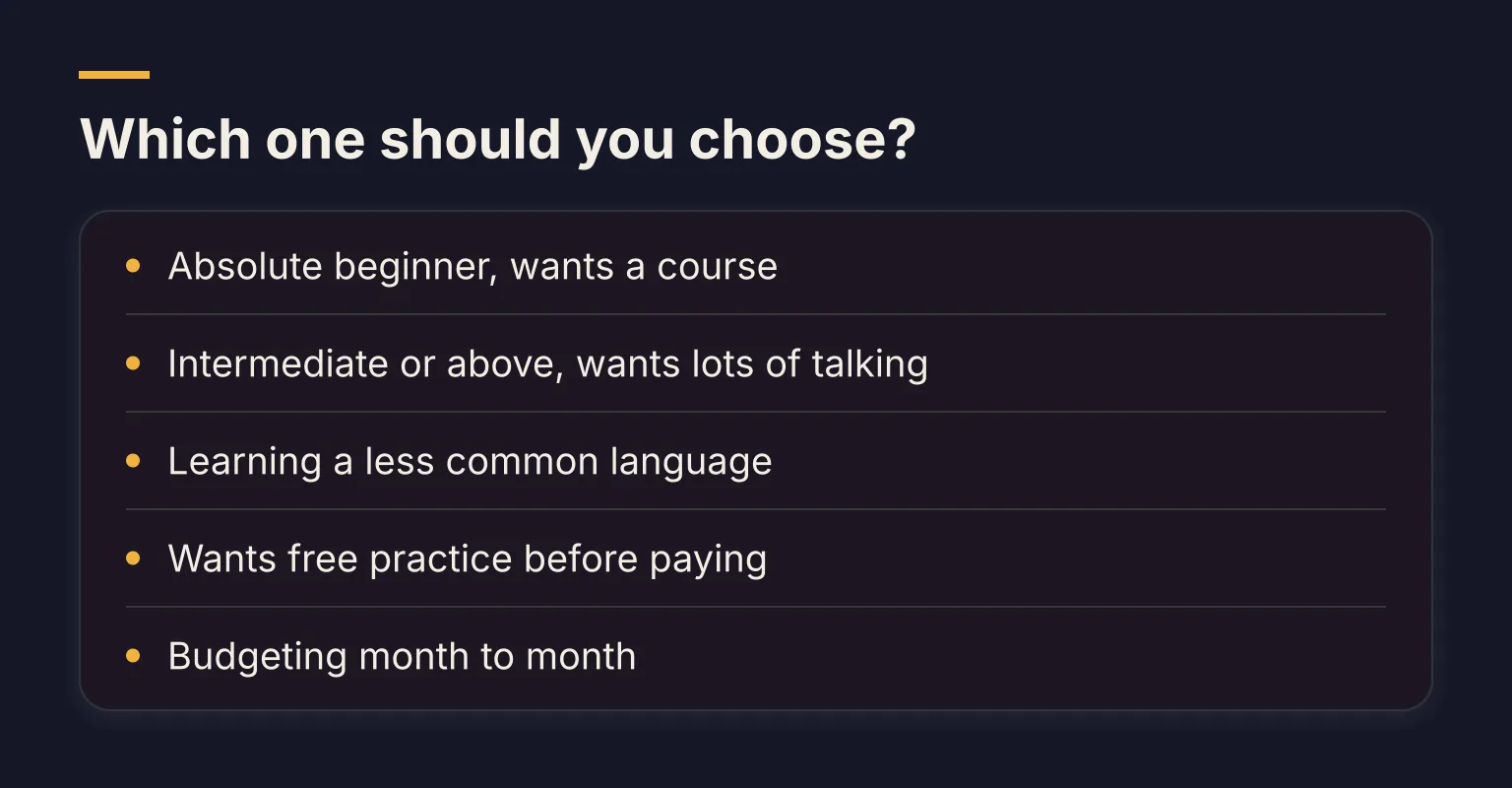
- Absolute beginner who wants a course: Speak. The lesson loop and instant pronunciation feedback are what a new learner needs.
- Intermediate or above who wants lots of talking: Langua. Open conversation, role plays and adjustable corrections give you more speaking per session.
- Learning a less common language: Langua. Its 23 languages against Speak's six is not close.
- Want free practice before paying: Langua. Its free tier is small but permanent; Speak's is a 7-day trial.
- Budgeting month to month: try Langua's free tier first, then Speak's trial, and see which you actually open every day.
For a wider view, our comparison of AI language learning apps for speaking covers the rest of the field. If Speak is on your shortlist against a free option, our Duolingo vs Speak comparison covers that pairing. And if you came here confused by LanguaTalk's name, Langotalk vs LanguaTalk explains how the two companies differ.
A third option: a lighter daily habit
Some readers comparing two full platforms don't actually need either. If your real gap isn't curriculum or feedback depth but simply speaking out loud more often, a small daily habit may help more than a new subscription. That's the idea behind TalkHabit, the app we make. It gives you a few minutes a day of voice conversation with an AI partner at your level, which says your mistakes back the right way as you talk. It's free for 5 minutes a day. Plus gives up to 10 minutes a day for $14.99 a month or $99.99 a year (US prices as of November 2026).
It isn't a replacement for Speak's course or Langua's feedback reports. It's built Spanish-first, with English, French and German also available, and it runs in a browser and on Android. Our guide to a five-minute daily speaking routine shows what that habit looks like. If that sounds like the missing piece, you can create a free account.