AI Conversation Partner: How It Works for Speaking Practice
By Primoz, Founder of TalkHabit
Published · Updated · 9 min read
An AI conversation partner is a chatbot or voice app you can speak your new language with, any time, without booking anyone or fearing embarrassment. It's good for regular speaking reps: it's always available, it lowers the pressure, and it gives instant feedback. It can't fully replace a person, though. Its feedback is shallower, it rarely makes you work through a misunderstanding, it can mishear accents, and it misses cultural nuance. The best use is five focused minutes a day of speaking aloud, not an hour of typing, with a human partner or tutor for the parts AI can't do yet. Used that way, an AI partner is a practice tool, not a replacement for talking with people.
What an AI Conversation Partner Is
An AI conversation partner is software that talks with you in the language you are learning. You speak or type, it responds, asks questions, and often corrects you gently. Unlike a fixed lesson app, the conversation goes wherever you take it, so you practise the messier skill of thinking and speaking in real time.
It helps to be clear about what such a partner replaces and what it does not. It replaces the logistics of finding someone to talk to: scheduling, cost, and the nerve it takes to speak to a stranger. It does not replace a human's ability to misunderstand you in interesting ways, negotiate meaning with you, or explain why a correction matters.
What AI Partners Do Well
Research on conversational agents in language learning points to a consistent set of strengths.
Always available. Your partner is there at 6 a.m. or midnight. That matters more than it sounds: studies suggest the biggest gains come from regular practice, and an always-on partner makes daily sessions realistic.
Low pressure. Speaking a new language to people is scary. Learners report lower speaking anxiety and higher willingness to communicate when they practise with a chatbot first, which is why researchers describe chatbots as useful confidence-building tools for anxious speakers (a 2025 mixed-methods study in Humanities and Social Sciences Communications found exactly that).
Fluency and confidence gains. A user study of 160 English learners found LLM chatbot conversations had a positive educational impact, and worked especially well for learners at lower proficiency levels (Linköping University conference proceedings). Other reviews report gains in listening, vocabulary in context, and willingness to communicate (Journal of China Computer-Assisted Language Learning).
Immediate feedback. Corrections arrive seconds after your mistake, while the sentence is still fresh in your mind.
If you are looking at an AI chat for language learning for the first time, these four strengths are the reason to try it. The honest limits are the reason not to rely on it alone.
Where AI Partners Fall Short
Knowing the weak spots helps you use the tool for what it is good at.
- Little negotiation of meaning. In a real conversation, when you are misunderstood, the other person asks you to rephrase. That repair work is one of the most valuable things a conversation does for your language. A friendly AI tends to guess your meaning and move on, so you lose that workout. Reviews of the research note that agents miss human features like asking for repetition or adjusting speech, which is exactly where much of the learning happens (Journal of China Computer-Assisted Language Learning).
- Shallow feedback. Corrections often fix the surface: a wrong ending, a missing article. A Cambridge research review of AI in language learning stresses that AI tools can assist with specific tasks but fall short of the truly personalised, in-context feedback a human gives, so you often learn what was wrong but not why (Cambridge University Press & Assessment).
- Accent and recognition problems. Speech recognition mishears some accents and mispronunciations, which can frustrate learners or, worse, give wrong corrections. Test how well a tool hears you before trusting it.
- Over-reliance risk. If every conversation is with a patient machine, you can get comfortable and then freeze with a real person who interrupts, changes topic, or does not understand you at all. Researchers recommend using AI alongside human interaction, not instead of it.
One more practical note: voice beats typing. Speaking aloud is the whole point of a conversation partner. Text chat builds reading and phrasing, but only speaking out loud trains your mouth, your rhythm, and your courage. If a tool works by voice, use it by voice.
A Five-Minute Method That Produces Real Reps
Here is a simple loop you can run with almost any AI conversation partner. Do it out loud, every day.
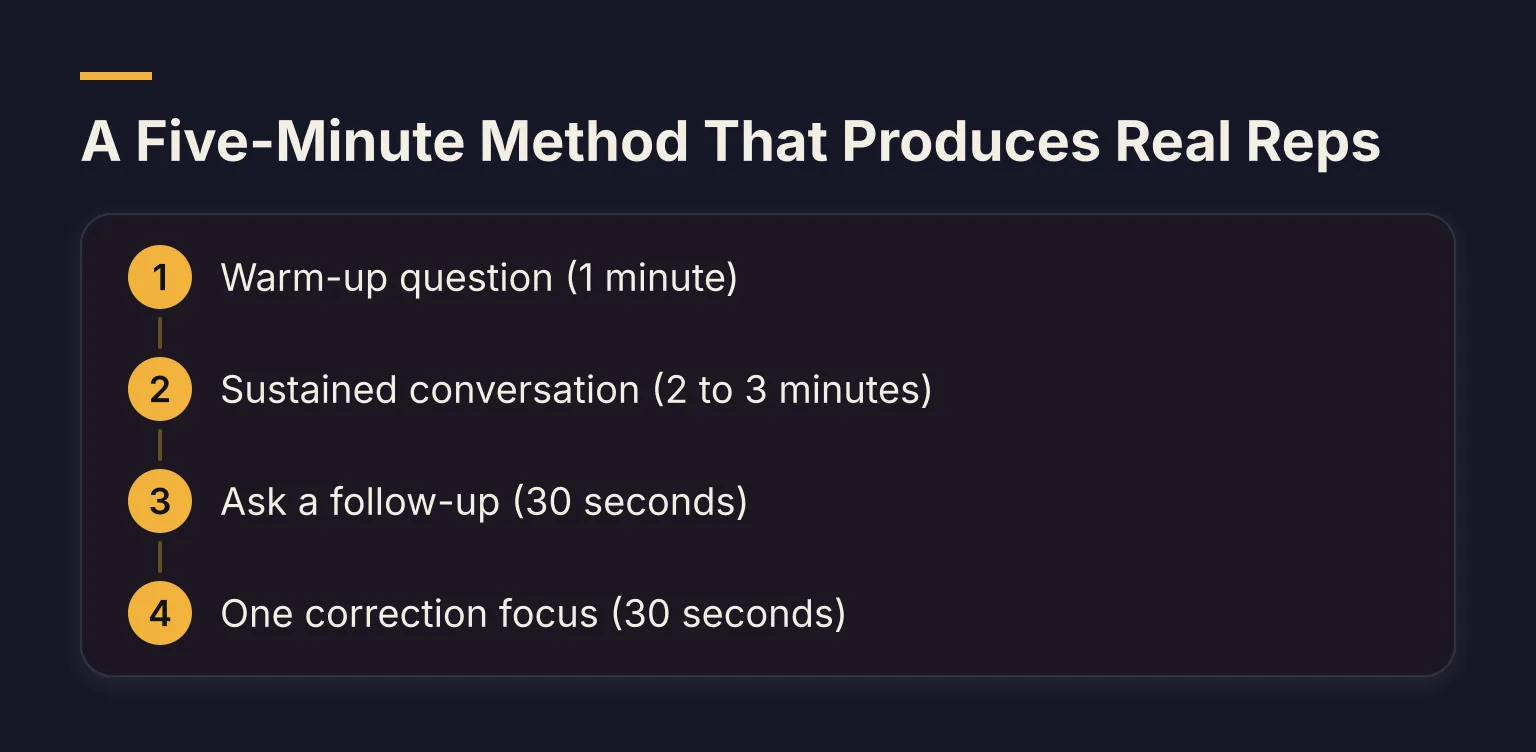
- Warm-up question (1 minute). Ask or answer one easy question in your target language, for example what you ate today or what you did this morning. This gets your brain into the language without pressure.
- Sustained conversation (2 to 3 minutes). Pick one topic and stay on it. Do not jump between subjects; depth beats variety. Try to speak in full sentences, even short ones.
- Ask a follow-up (30 seconds). Make the AI ask you at least one follow-up question, or ask it one yourself. Follow-ups force you to produce new sentences instead of rehearsing the same ones.
- One correction focus (30 seconds). Look at the corrections from the session and choose one thing to fix, say a verb tense or a phrase you keep getting wrong. Say three sentences using it correctly before you close the app.
That is it. The method works because it is short enough to do daily and ends with an active fix rather than a vague intention. For more ways to shape short sessions, see Daily Language Speaking Practice: A 5-Minute Routine, and if you have no partner set up at all yet, Language Practice at Home: Speaking Without a Partner covers the options from scratch.
How to Judge Any AI Conversation Partner
Whichever tool you try, check the same five things:
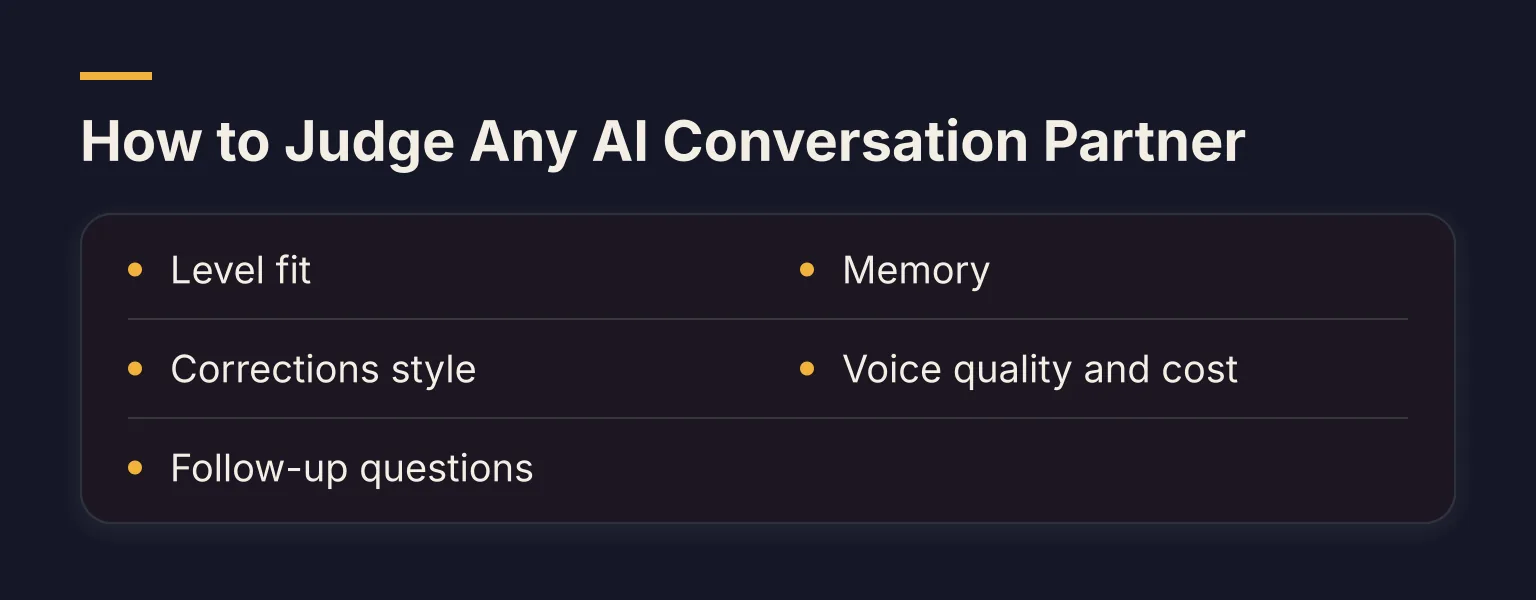
- Level fit. Can it match your beginner, intermediate or advanced level, and adjust when you improve? A mismatch either bores you or buries you.
- Corrections style. Does it correct gently and keep the conversation going, or does it interrupt every sentence? Gentle and continuous works better for building a habit.
- Follow-up questions. A partner that only answers you makes you lazy. One that asks back keeps you producing language.
- Memory. Does it remember earlier sessions so conversations build on each other, or do you start from zero each day?
- Voice quality and cost. Does voice input work well for your accent, and does the free tier or trial give you enough sessions to judge it? Check each vendor's own site for current pricing.
For a deeper look at chat-style practice and the prompts that make it work, see AI Chatbot for Language Learning: How to Use One Well. To compare specific apps, our AI language learning apps comparison checks six of them against these points. If your target language is English, Free AI English Speaking Practice: Find the Right Partner covers the English-only version of this question, and How to Learn Fluent English Speaking shows where AI practice fits in a stage-by-stage plan.
When a Human Partner Is Still the Better Choice
Use a human when you need what AI cannot give yet. A tutor or conversation exchange is better for deep feedback on why something sounds wrong, practice with genuine misunderstanding and repair, cultural nuance, and the real-world stress of talking to a person. A study comparing human and chatbot interaction found each context shaped learners' willingness to communicate differently and recommends combining the two rather than choosing one (Innovation in Language Learning and Teaching).
A practical split: AI partner for daily reps, human partner weekly or monthly for the hard parts. Most learners who quit speaking practice quit because the sessions were too big. Five AI minutes a day plus an occasional human conversation beats an ambitious plan that collapses in week two.
Getting Started: Your First Week
You need three things: a device with a microphone, headphones if you are in a shared space, and an honest choice of level. Choose a level where you can follow the conversation with some effort, not one where you understand nothing. Our guide to choosing your speaking level helps if you are unsure.
Then run this plan:
- Days 1 to 3: one five-minute spoken session per day, following the loop above. Do not add anything else.
- Days 4 to 5: pick one correction focus per day and reuse it in the conversation on purpose.
- Days 6 to 7: change the topic once mid-session to test yourself, and note how your comfort compares to day 1.
If five minutes feels easy, you have found the right dose, not a small one. The goal is a habit you keep, not a session you survive.
One way to run this method is TalkHabit, the app we make. It's built around one short voice conversation a day with an AI partner set to your level. The partner says your mistakes back the right way, asks follow-up questions and remembers your past conversations. It's built Spanish-first, with English, French and German also available, and works in a browser and in an Android app (the iPhone app isn't out yet). The free plan gives you five minutes a day. Plus gives up to 10 minutes a day for $14.99 a month or $99.99 a year (US prices as of November 2026), after a 7-day free trial. If you want to start speaking today, create a free TalkHabit account and try your first five-minute conversation.