Best Apps to Learn French in 2026: Which One Fits You?
By Primoz, Founder of TalkHabit
Published · Updated · 11 min read
There's no single best app to learn French. The right pick depends on what you need most. Duolingo is the best free habit-builder, and Babbel has the clearest grammar lessons. Pimsleur is the audio course that makes you speak on the move, Memrise is best for everyday vocabulary from native-speaker video, and Busuu for corrections from real French speakers. Most of these apps are light on actual speaking, though. If your goal is a conversation in French rather than a streak, pair whichever app you choose with some daily speaking practice.
If your budget is zero and speaking is the goal, our shortlist of free apps to practise speaking French covers AI partners, language exchanges and free audio courses.
How we framed this comparison
Plenty of ranked lists exist for French apps, and learners push back on them. In an r/learnfrench thread that ranks well for this question, the recurring advice is that no single app covers everything, and most people need more real speaking than any app gives them.
So instead of one flat ranking, this guide describes what each app does best and what it doesn't do. We compared them on five things, using each company's own pages, checked on 3 November 2026. We didn't run timed tests, so there are no scores.
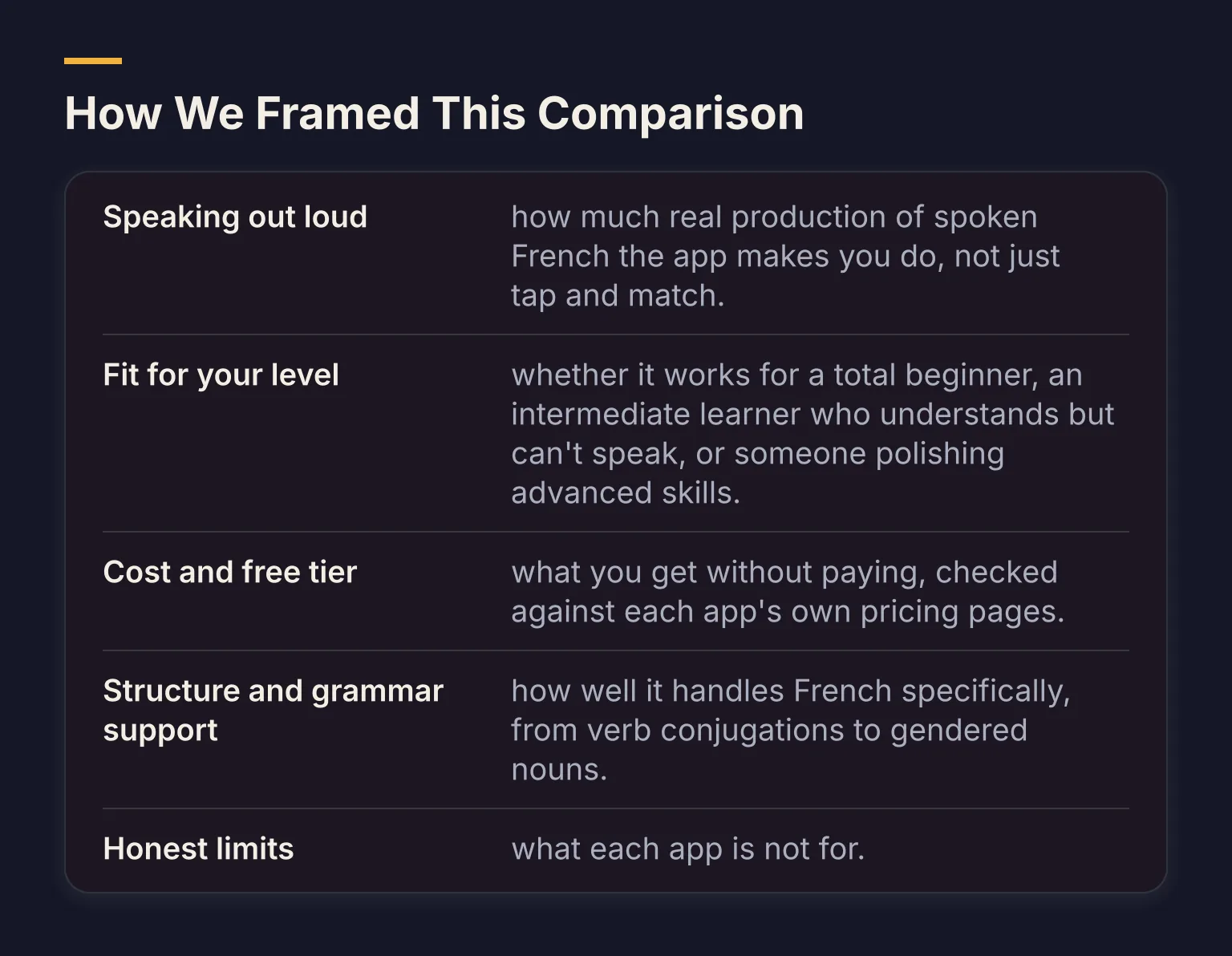
- Speaking out loud: how much spoken French the app makes you produce, not just tap and match.
- Fit for your level: whether it works for a total beginner, an intermediate learner who understands but can't speak, or someone polishing advanced skills.
- Cost and free tier: what you get without paying, from each app's own pricing pages.
- Structure and grammar support: how well it handles French specifically, from verb conjugations to gendered nouns.
- Honest limits: what each app is not for.
Here's the overview. Prices are US prices as of November 2026 and vary by country.
| App | Speaking focus | Structure | Free option | Paid plans (US, November 2026) |
|---|---|---|---|---|
| Duolingo | Low | High | Full course, with ads | Super and Max; price shown in the app |
| Babbel | Low to medium | High | First lesson of each course | From $8.95/month on a 12-month plan |
| Pimsleur | Medium (spoken answers) | High (audio course) | 7-day trial and a free first lesson | Audio-only $14.95/month; Premium $19.95/month |
| Memrise | Medium (AI role-play bots) | Medium | Limited lessons and videos | Pro from $61.99/year in the App Store |
| Busuu | Low to medium | High | Complete courses, with ads | Premium and Premium Plus; price shown in the app |
| TalkHabit | High (voice conversation) | Light | 5 speaking minutes a day | Plus $14.99/month or $99.99/year |
TalkHabit, in the last row, is our app. It's built Spanish-first, but French conversations work too: to try one, start on the free plan, no card needed.
The order below isn't a ranking. Each app is "best for" a different job.
Duolingo: best free app for building the habit
Best for: a zero-cost daily routine. Tradeoff: tapping isn't speaking.
Duolingo is the default answer for a reason. Learning is free, and the streak system is genuinely good at getting you to open the app every day. If your problem is consistency rather than ability, Duolingo's free tier is hard to beat. The paid Super plan removes ads and adds extras such as practice built from your mistakes. Duolingo Max adds AI Roleplay and Video Call for French learners, in the mobile app only.
The honest limit: Duolingo is not a speaking app. Is Duolingo effective for French? It's effective for vocabulary, reading recognition and showing up daily. It's weak for real conversation, because most exercises are tap-the-word rather than building sentences out loud under time pressure. Learners who quit after a long streak often describe exactly this gap: hundreds of days in, still unable to hold a conversation. If that's you, our piece on Duolingo alternatives for learners who want to speak covers where to go next.
Babbel: best structured lessons for beginners
Best for: beginners who want a clear path through grammar. Tradeoff: no permanent free tier.
Babbel is the most structured of the big-name apps. Lessons are short and explain grammar explicitly, which Duolingo mostly avoids. For French, that matters: it's easier to understand why verbs conjugate the way they do, and why every noun has a gender, when someone actually explains it.
Babbel is subscription-based, but you can try it first. According to its free-trial help page, registering is free and the first lesson of every course is free. In the US in November 2026, plans ran from $17.95 for one month down to $8.95 a month on a 12-month plan, with a $299.99 lifetime option. Babbel's US pages advertise a 14-day money-back guarantee. It's also testing an AI conversation partner, still in beta and in the mobile app only, which covers French.
The honest limit: like Duolingo, Babbel is mostly reading, tapping and short repetition exercises. There's some speaking built in, but it isn't the core of the product. If you're unsure about committing, use the free first lessons to check that the teaching style suits you.
Pimsleur: best audio course for speaking and listening
Best for: learning while commuting, walking or driving. Tradeoff: very little reading and writing.
Pimsleur is the classic audio method, and it's the one traditional course where you genuinely speak out loud in every lesson. Its core lessons last about 30 minutes, and you're constantly prompted to say French phrases aloud before you hear the answer. For French, it's a strong pick if your goal is pronunciation and being understood.
According to its FAQ, Pimsleur offers a 7-day free trial, then subscription plans: audio-only, Premium with interactive tools, or All Access, which covers every language. You can also buy courses outright and keep them. The French course page offers a free first lesson. On pimsleur.com in November 2026, the US audio-only plan was $14.95 a month and Premium $19.95 a month.
The honest limit: Pimsleur is audio-first to a fault. If you learn best by seeing words written down, or you want to read and write French, it will feel lopsided. And while you speak a lot, it's structured call-and-response, not free conversation.
Memrise: best for everyday vocabulary
Best for: vocabulary and hearing real native speakers. Tradeoff: the free plan is limited.
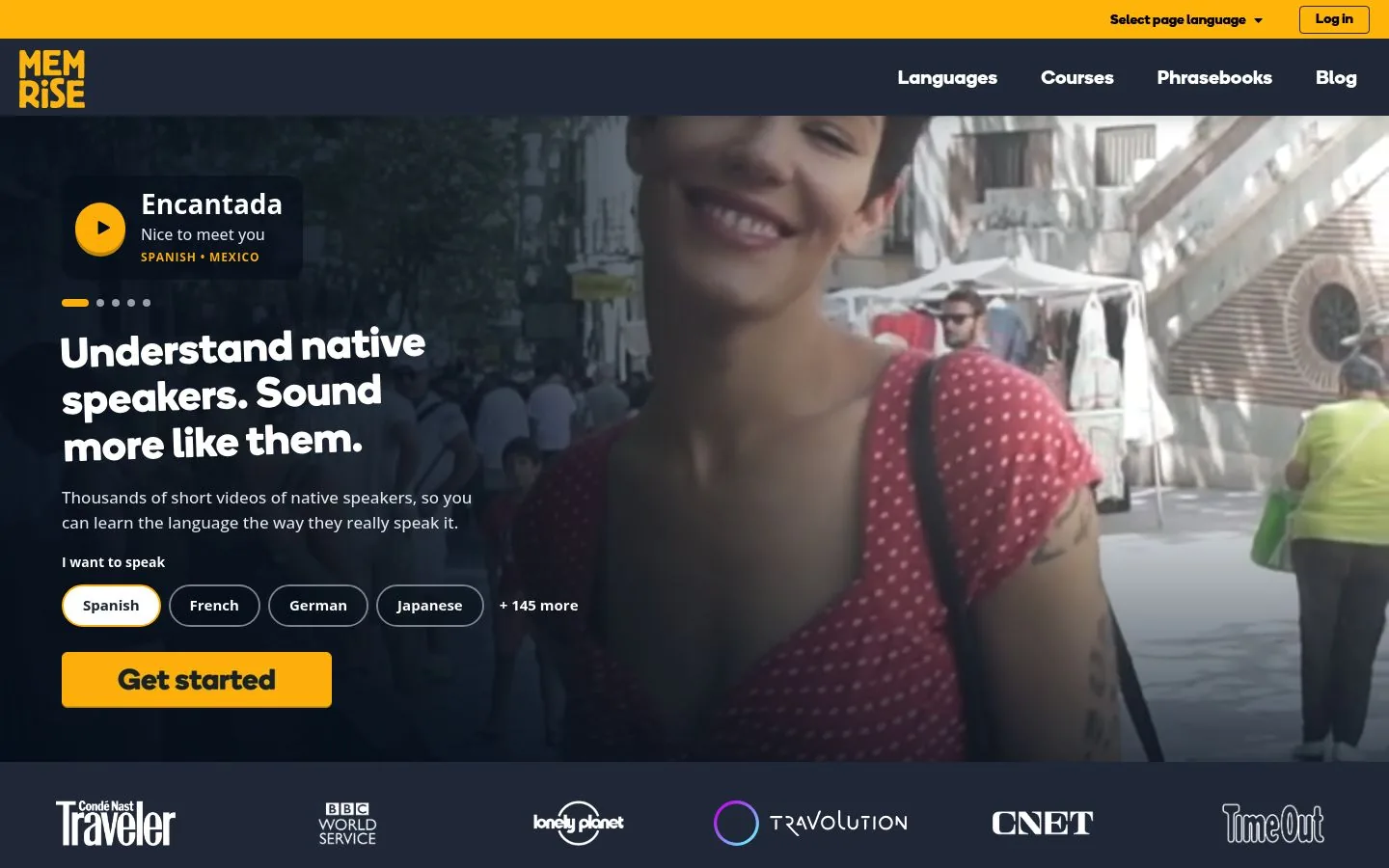
Memrise takes a different angle from the course apps. It teaches words and phrases from real-life situations, backed by thousands of short videos of native speakers, so you hear how French actually sounds rather than a clean studio recording. Its app also has AI role-play bots it calls Buddies for speaking practice. You can start for free. The paid Pro plan unlocks all lessons, all native-speaker videos and unlimited speaking practice, and the US App Store listed it at $61.99 a year (as of November 2026).
The honest limit: the free plan caps the lessons, videos and conversations you can access. Memrise builds vocabulary and recognition more than free-flowing speaking.
Busuu: best for community feedback and grammar review
Best for: getting corrections from real French speakers. Tradeoff: the speaking tools are on the top plan.
The standout feature at Busuu is its community. You complete exercises, fluent French speakers correct and comment on them, and you can do the same for learners of your language. Busuu's plan comparison shows a genuinely usable free tier: complete courses and community feedback, with ads. Premium adds grammar and vocabulary review tools and removes ads. Premium Plus adds AI conversations and pronunciation feedback.
The honest limit: the speaking-focused tools are on Premium Plus only, so the free experience is more about courses and written feedback than talking. Community corrections also depend on other users, so they aren't instant.
TalkHabit: daily speaking practice without the pressure
Best for: a few minutes of spoken French every day. Tradeoff: it's a speaking tool, not a course, and French isn't its main language.
TalkHabit is the app we make. You have short voice conversations with a personal AI partner who adjusts to your level, from beginner to advanced. The partner asks follow-up questions, says your mistakes back the right way instead of stopping you, and remembers your earlier conversations. After a call on the web, you see a few sentences you actually said next to the corrected versions. You can then shadow them in your partner's voice to borrow the rhythm of spoken French.
The honest limits: TalkHabit is built Spanish-first. French conversations work, but the daily grammar focus and verb practice are Spanish-only for now. It has no lesson tree or vocabulary course, so you'll still need one of the apps above for new material. It runs in a browser and on Android, and there's no iPhone app yet. It's free for 5 speaking minutes a day. Plus gives up to 10 minutes a day for $14.99 a month or $99.99 a year, after a 7-day free trial.
So, is Duolingo or Babbel better for French?
This is the most-asked comparison, and the honest answer is that they're similar products with different teaching philosophies.
- Pick Duolingo if you want to spend nothing and the game format will actually keep you coming back.
- Pick Babbel if you want grammar explained directly and don't mind paying for a subscription.
- Neither will make you conversational on its own. Both are light on real speaking. Whichever you pick, add some speaking to the routine.
Is there an app better than Duolingo? For conversation skills, almost any speaking-focused tool beats it. For free habit-building, Duolingo is still the benchmark.
Which app fits how you practise?
A quick decision guide based on your main goal:
- "I'm a complete beginner and want structure." Babbel, or Duolingo if you won't pay.
- "I want the cheapest or free option." Duolingo's free tier, Memrise's free plan, or Busuu free with ads.
- "I have a commute and want to speak and listen better." Pimsleur.
- "I keep forgetting everyday words." Memrise, for vocabulary from native-speaker video.
- "I want humans to correct me." Busuu's community, or a tutor if your budget allows.
- "I want to actually speak French, daily." An AI conversation partner or a language exchange alongside a structured app. Our free French speaking apps guide compares the free options, TalkHabit included.
How to combine an app with daily speaking practice
Whatever French app you choose, the pattern that gets people conversational is the same: study a little, then speak a little, every day.
- Do your lesson (Duolingo, Babbel or Pimsleur) to pick up new words and grammar.
- Use them out loud straight away in a short speaking session, with an AI partner or a conversation partner, so the new material moves from recognition to production.
- Keep the sessions short. Five focused minutes of speaking a day beats an hour-long cram on Sunday. Our guide to a five-minute daily speaking routine walks through it.
This works because of the gap most learners hit: they understand far more than they can say. Closing that gap takes output, and output needs a low-pressure place to happen. If you have no one to talk to, practising speaking without a partner covers the options.
What no app can do
Be realistic about limits. No app gives you the unpredictability of a real conversation in a Paris café, and no streak replaces the nerves you'll feel the first time you order in French. Apps are the practice ground, not the match. That's why low pressure matters: if speaking practice feels safe and repeatable, you'll actually do it, and real conversations get easier.
For AI options in more depth, see our comparison of AI language learning apps for speaking. If you're learning another language too, our Spanish apps guide and Mandarin apps guide use the same approach.
If you'd like to try a short daily conversation in French alongside your course app, you can create a free TalkHabit account and use the free five minutes a day.